
AC Repair & Installation in Lowell, MA
Central air and ductless cooling, repaired or replaced, for Lowell's hot and humid summers.
Lowell summers are short, but they are humid, and a few weeks in the upper 80s and 90s are enough to find every weak part in an air conditioner. We repair and replace central air systems (an outdoor condenser plus an indoor coil on the furnace or on an attic air handler) and ductless systems with wall or ceiling heads, in houses, condos, triple-deckers and light commercial spaces.
When you call, you talk to someone who knows HVAC systems. We ask what the system is doing, how old it is and what you have already checked, then schedule a visit that works with your timeline. On site, we measure before we replace anything, explain what we found in plain language, and give you an honest estimate. If a repair is the sensible answer, we say so.
Signs you need AC repair
- Air from the vents feels warm or barely cool; a healthy system usually blows air roughly 15 to 20°F colder than the air going in.
- The outdoor unit hums but its fan does not spin, often a failed capacitor or fan motor.
- Ice on the copper line at the outdoor unit, or frost on the indoor coil.
- Water dripping from an attic air handler, or a ceiling stain under it: a clogged condensate drain or a cracked pan.
- The system turns on and off every few minutes (short cycling).
- The breaker trips when the compressor starts.
- Buzzing, rattling or grinding from the outdoor unit.
- Upstairs rooms stay several degrees warmer than downstairs, even with the system running all day.
- The house feels clammy even though the AC never seems to stop.
Check these before you call
Make sure the thermostat is set to Cool and below room temperature, and replace its batteries if it has them. Look at the air filter. Check the breaker and the disconnect switch beside the outdoor unit. Some systems have a float switch on the drain pan that shuts the cooling off when the pan fills with water; if the pan is full, that is the problem to fix. Please do not open electrical panels, spray the unit while it runs, or add refrigerant yourself: refrigerant work is legally restricted to certified technicians for good reason.
Common AC problems we fix
| What you notice | Common causes | What we usually do |
|---|---|---|
| Outdoor unit hums, fan still | Failed run capacitor, worn fan motor | Test and replace the capacitor or motor |
| Warm air, outdoor unit silent | Tripped breaker, burnt contactor, thermostat wiring, blown low-voltage fuse | Find the open circuit, repair the wiring or replace the part |
| Frozen coil or iced line | Dirty filter, weak blower, low refrigerant from a leak | Restore airflow; locate and repair a leak before recharging |
| Water leaking indoors | Clogged condensate line, cracked drain pan, failed condensate pump | Clear the drain, add a float switch, replace the pan or pump |
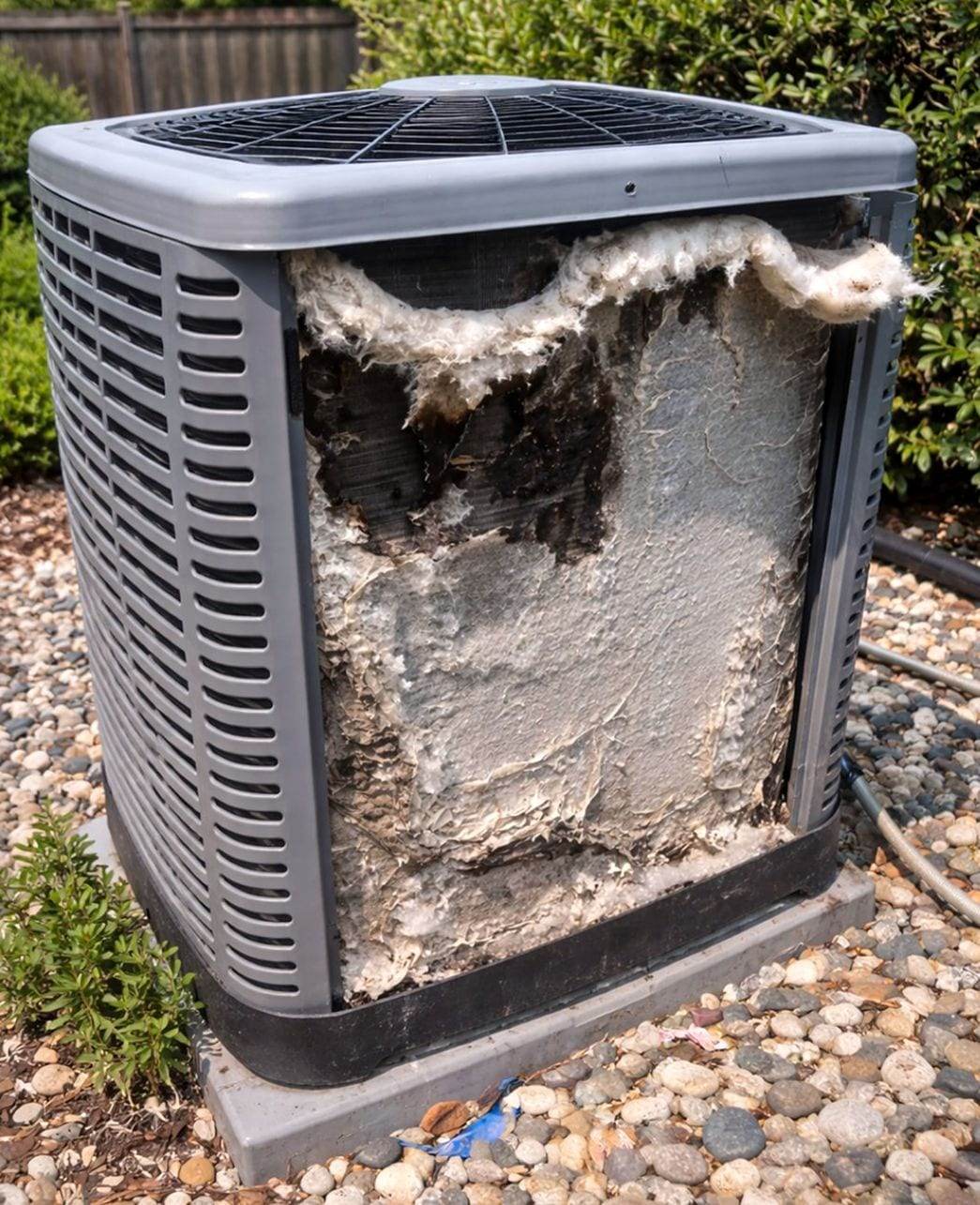
| Weak cooling on hot afternoons | Condenser coil blocked by cottonwood fluff, grass clippings or dirt | Clean the coil and check the refrigerant charge |
| Short cycling | Oversized system, thermostat in the sun, wrong refrigerant charge | Diagnose first; sometimes a thermostat move is the whole fix |
Repair or replace?
No single number decides it. Put your system in the column that fits each row; if most of your answers land on the right, it is worth getting a replacement estimate before the next repair.
| Factor | Repair usually makes sense | Replacement deserves a look |
|---|---|---|
| System age | Under about 10 to 12 years | 15 years or older |
| Breakdown frequency | First real problem in years | Several repairs in the last two seasons |
| Refrigerant | R-410A or a newer refrigerant | R-22, which is no longer produced and costly to recharge |
| SEER rating | 13 SEER or higher on the label | Older 8 to 10 SEER equipment |
| Efficiency and comfort | Bills steady, house stays comfortable | Bills climbing, never kept up on humid days |
| Leaks | One leak at a fitting or valve, repaired once | The indoor coil leaking again after a repair |
We will tell you which column you are in. If a repair is the better value, that is what we will recommend; we do not push replacements you do not need.
Sizing a new system
Bigger is not better. An oversized air conditioner cools the house in short bursts and shuts off before it has pulled the moisture out, so a Lowell July still feels sticky indoors. A proper load calculation looks at each room's windows, sun, insulation and duct location. The guide below gives you a starting range.
Cooling size guide
A quick first number for central air or the cooling side of a heat pump. It does not replace a room-by-room load calculation, but it tells you whether a quote is in the right range.
Enter your numbers and press Estimate cooling size.
Rule-of-thumb cooling loads
| House | BTU per hour per square foot | Example: 1,200 square feet |
|---|---|---|
| Well insulated, newer windows | 12 to 16 | 14,400 to 19,200 BTU/h |
| Average, some upgrades | 15 to 20 | 18,000 to 24,000 BTU/h |
| Little insulation, original windows | 19 to 25 | 22,800 to 30,000 BTU/h |
Central air, ductless or a heat pump?
Central air needs ductwork. If your house has ducts in good shape, a new condenser and matched coil is the most direct replacement. Radiator houses usually get cooling from ductless mini-splits instead. And many owners replacing central air now choose a heat pump: the outdoor unit looks the same, but it also heats the house through the spring and fall, and with a cold-climate model, through much of the winter.
What an installation involves
- A load calculation and a look at the ducts, the electrical service and where the outdoor unit can go.
- An estimate that names the equipment, the permits the job needs and the expected timeline.
- Removal of the old equipment, with the refrigerant recovered, never vented.
- The new outdoor unit set level on a pad or brackets, a new or flushed line set, and an indoor coil matched to the outdoor unit.
- A pressure test and deep vacuum before the refrigerant is released, then the charge set to the manufacturer's specification.
- Testing temperatures, airflow and drainage, and a walk-through of the thermostat and filter.
AC questions
What SEER rating should I choose in Lowell?
New equipment is rated in SEER2, a stricter test than the old SEER numbers, so a SEER2 figure looks lower for the same machine. Federal rules set the minimum for new central air conditioners in the northern states at about 13.4 SEER2. Because Lowell's cooling season is short, the step from a mid-range unit to a top-tier one pays back slowly on the electric bill alone. The bigger comfort gains usually come from correct sizing, a two-stage or variable-speed compressor that handles humidity better, and ducts that are sealed and sized for the airflow.
How long does an AC installation take?
Replacing an existing central system with a matched outdoor unit and coil is often a one- or two-day job. Adding ductwork, running a new line set through finished walls, or upgrading the electrical service takes longer. You will get the expected timeline with the estimate, before anything is ordered.
Do I need a permit to replace central air in Lowell?
Usually, yes. In Massachusetts, replacing or adding central air typically involves an electrical permit for the outdoor unit's circuit and disconnect, and depending on the scope, building or sheet metal permits for new equipment and ductwork, followed by an inspection. Requirements change and depend on the job, so ask any contractor which permits your project needs; a good estimate spells them out.
My air conditioner runs all the time, but the house still feels damp. Why?
The usual suspects are an oversized system that cools the air quickly and shuts off before it removes moisture, a thermostat fan set to "On" instead of "Auto" (the fan blows the water off the coil back into the house), or low airflow from a clogged filter. Each one is fixable once we know which it is.
Can you add central air to a house heated by a boiler?
Only by adding ductwork somewhere. In many Lowell houses that means an air handler in the attic feeding the top floor through short ducts, with the lower floors handled by ductless heads. See ductless mini-splits for the room-by-room option.
Should I cover my outdoor unit for the winter?
A plain air conditioner can take a top-only cover, or nothing at all. Do not wrap it on all sides: a full wrap traps moisture and makes a cozy winter home for mice that chew wiring. Never cover a heat pump, because it runs all winter.